
On foot
10.00 km
A walk around Watervliet
The walk starts at Het Stee, and it is Veldstraat that takes us out of the village towards Muizenhol. Take in the view of the dykes and the vast polder plain that links Watervliet with Boekhoute, stretching right up to the Belgian-Dutch border.
However, we head south and cross the Stenenschuurbrug. Enjoy the view of the Leopold Canal. Via Landsdijk, a hamlet with a quaint little church and a magnificent view of the neighbouring village of Bassevelde, we return to the canal, where we cross by foot ferry. Passing the former Watervliet Monastery, we arrive back at the Stee.
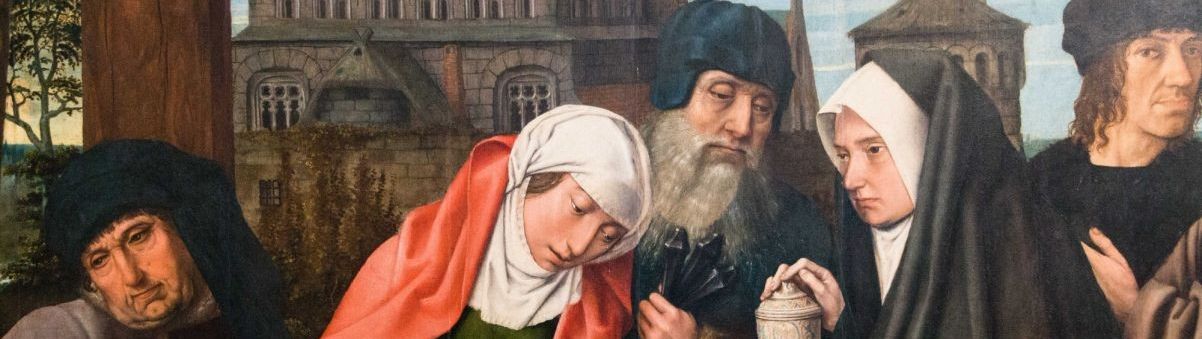
"Nood Gods", Master of Frankfurt
Most of the masterpieces of Flemish art history are on display in major museums in major cities. But one of the most impressive works by the Flemish Primitives can be found quite simply in the Church of Our Lady at Stee in Watervliet. Here hangs the painting ‘God’s Distress’ by the Master of Frankfurt, whose works can be admired in Frankfurt, Antwerp and Madrid. But also in Watervliet.
-----
Lauwerijn and Watervliet
Jeronimus Lauwerijn began his career as a clerical assistant to the Chief Tax Collector of Flanders. His role involved collecting tax revenues, and in this capacity he rose to the very top of the social hierarchy in Flanders and amongst the Burgundians whilst living in Bruges. In 1503, it was Philip the Fair who knighted him. He served as a councillor and chamberlain to Maximilian of Austria. He also looked after the children of Philip the Fair, the most famous of whom we know as Emperor Charles V. In the Meetjesland region, he invested in land reclamation projects and dreamt of turning Watervliet into a major port city. The Church of Our Lady in Watervliet (and its art treasures) is regarded as a remnant of Lauwerijn’s power in our region. His tombstone can be seen in the choir aisle. The church was built in 1501. A neo-Gothic tower was added in 1893. The tower and the baptistery were severely damaged at the end of the war in 1944 but were rebuilt in 1952.
-----
Further information and opening hours:
www.vlaamsemeestersinsitu.be
Group packages and guided tours:
Information and bookings via Sint-Laureins Tourist Office, 09 218 76 47 or dienstvrijetijd@sint-laureins.be
www.meetjeslandsegidsen.be
www.buitenzinnig.be
www.plattelandscentrum.be
-
Parish Church of Our Lady of the Assumption
The renowned Church of the Assumption of Our Lady was founded by Jeronimus Lauwerijn of Bruges and built between 1501 and 1540. It is popularly known as the ‘Cathedral of the North’ because of its strikingly opulent interior. Upon entering the church, you are struck by the high vaults, rows of columns and pointed-arch windows. ‘The Cathedral of the North’ or ‘Little St Bavo’ is so named because of its striking resemblance to St Bavo’s Cathedral in Ghent. The high altar at Watervliet is identical to that in Ghent. The name was therefore given not only because of the opulent interior but also because of the resemblance to Ghent.
The majestic high altar (featuring a statue of the Madonna) in black and white marble by Faydherbe (1652–54), with a large altarpiece by De Crayer.
High altar by Lucas Faydherbe, 1652–55, a portico altar in white and black marble with twisted columns featuring Corinthian capitals, an attic frieze crowned with a cartouche, flanking statues of angels and a seated statue of Our Lady with the Infant Jesus on the pinnacle. Altar of Our Lady. Altar of Saint Sebastian. Altar in the ash chapel, by the Rooms workshop (Ghent), grey stone and marble, dating from 1893. -
A farmstead with a kiosk, a pump and a "butter bench"
In Watervliet’s beautiful market square, or ‘Stee’, we can see the historic village pump dating from 1781. It is made of blue bluestone and was restored in 1996. One of the original three butter banks, dating from 1788, has been preserved. This unique village scene has been officially listed since 1986 and forms the heart of one of the fifteen most beautiful Flemish villages.
-
Of swamp fever, the Leopold Canal and the almshouse
The Leopold Canal (from Boekhoute to Heist) and the Schipdonk Canal (from Deinze to Heist) were intended to relieve the polders of excess rainwater. The canal was to put an end to the flooding that was a problem at the time once and for all. This would put an end to the swamp fever that was afflicting the residents. As the hospitals were too far away for the residents of Sint-Laureins who were suffering from swamp fever, work began on the construction of the stately Godshuis. From far and wide, you can see the dome of the Godshuis towering above the centre of Sint-Laureins.
-
Creeks, polders and local cuisine
There are many theories about the origin of the creeks. Some claim that the creeks are old peat pits that were initially created by the extraction of peat from the marshes or peatlands. Another account suggests that the region was ravaged by major floods in the Middle Ages. The force of the water carved out deep channels that filled with water. The creeks and the dykes, with their picturesque dyke cottages, characterise the landscape. In our many restaurants and cafés, you can enjoy the delicious local speciality, ‘Paling op Sentse wijze’.
-
Paster Sies
Paster Sies, the thinking pastor who served from 7 February 1918 to 5 December 1947, became a true local legend. His stories are brought to life during the wonderful experiential tour ‘Out and About with Paster Sies’. The walk takes about 3 hours. Bookings can be made for groups of 15 or more.